Erectile Dysfunction and Premature Ejaculation: Why They Overlap and What Helps
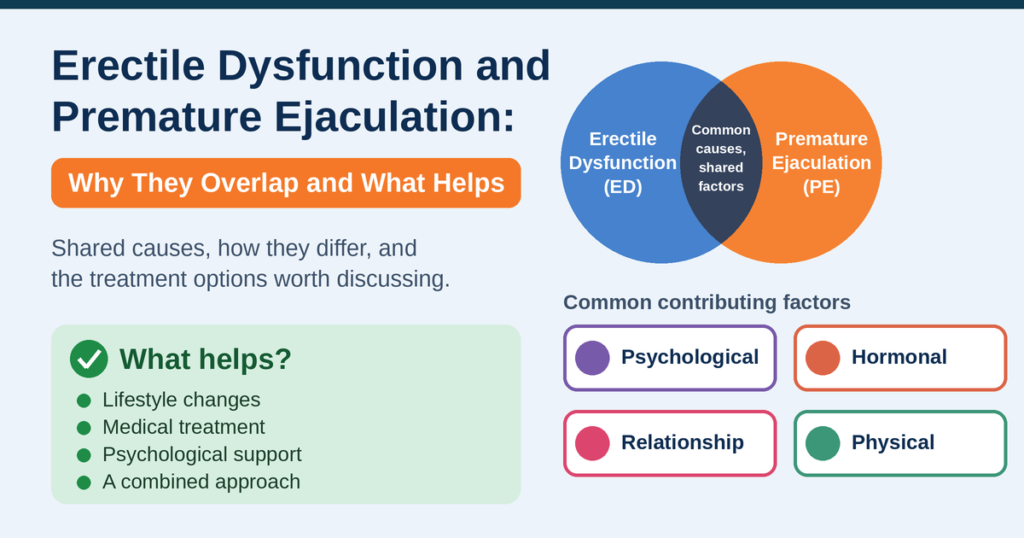
Yes, erectile dysfunction (ED) and premature ejaculation (PE) can occur in the same man, and each can make the other worse. They are separate conditions with different definitions and different treatments, but they share causes such as anxiety, stress, relationship strain, alcohol, and some medical conditions. Understanding where they overlap helps you ask a doctor the right questions and avoid treating one problem while ignoring the other.
This guide explains what each condition is, why they so often appear together, what the evidence says about treatment, and where tadalafil fits in. It also covers safety points that are easy to miss, particularly around buying medicines online.
Key Points at a Glance
- ED is difficulty getting or keeping an erection firm enough for sex. PE is ejaculating sooner than you or your partner would like.
- Both are common, and occasional episodes are usually not a cause for concern.
- Anxiety can drive both problems and can create a loop in which one feeds the other.
- Tadalafil is a licensed treatment for ED. It is not a licensed treatment for PE.
- Persistent problems deserve a medical check, because ED in particular can signal diabetes, heart disease, or other conditions.
What Is Erectile Dysfunction?
Erectile dysfunction, sometimes called impotence, means being unable to get an erection, or unable to keep one long enough to have sex. NHS information notes that it is very common, particularly in men over 40, and that depending on the cause you may still get erections at other times, such as on waking.
Almost every man fails to get or keep an erection now and then. Tiredness, stress, or too much alcohol are typical triggers, and a single bad night is not ED. The picture changes when it keeps happening. Frequent difficulty may be linked to conditions such as diabetes, heart and blood vessel disease, high blood pressure, hormonal problems, or side effects of other medicines.
For a deeper look at how doctors separate causes, see our guide to psychological versus physical erectile dysfunction.
What Is Premature Ejaculation?
Premature ejaculation means ejaculating more quickly than a man and his partner would like. International guidelines referenced by the NHS define it as regularly ejaculating within about one minute of penetration. If the timing causes persistent distress, it is a problem that can be helped with treatment, and many men who stick with treatment find it improves.
The NHS describes two types:
- Primary (lifelong) PE: you have always had the problem. Causes are often psychological, for example a distressing early sexual experience or learned habits.
- Secondary (acquired) PE: it developed recently. Both psychological and physical causes can be involved, including heavy alcohol use, recreational drugs, and inflammation of the prostate gland (prostatitis).
Occasional PE is common and, for some couples, is not a problem at all. Whether it needs treatment depends on distress, not on a stopwatch alone.
Why ED and PE Often Occur Together
The two conditions are different in how the body works. An erection depends mainly on blood flow, nerve signals, and arousal. Ejaculation is a reflex controlled by the nervous system. Even so, they overlap in daily life for several reasons.
The Anxiety Loop
Worry is the most common bridge between the two. A man who has lost an erection once may start monitoring his body during sex, a habit sometimes called spectatoring. That tension can make it harder to stay aroused, which feeds ED. Some men then rush toward ejaculation before the erection fades, which can look like or worsen PE. Afterward, embarrassment and frustration raise anxiety for the next time.
The cycle can run in the other direction too. Repeated early ejaculation can erode confidence and lead to avoiding intimacy, which in turn makes erections less reliable. Our article on how performance anxiety can make ED worse over time explains this loop in more detail, and stress-induced erectile dysfunction covers the stress side.
Shared Physical and Lifestyle Contributors
Several factors can affect both erections and ejaculation:
- Alcohol and recreational drugs. The NHS lists heavy drinking and drug use among the physical causes of acquired PE, and they are well-known contributors to ED as well.
- Depression, stress, and relationship difficulties. These are listed as psychological causes of PE and are also frequent contributors to ED.
- Prostate problems. Prostatitis is named as a possible cause of acquired PE, and prostate conditions can also affect sexual function more broadly.
- Medical conditions. Diabetes, in particular, is strongly associated with ED. See can diabetes cause severe erectile dysfunction for the connection.
The practical takeaway is that a man with both problems should not assume they are the same issue, nor that fixing one will automatically fix the other. A clinician can sort out which is leading.
Does Treating ED Help PE?
Sometimes. Some clinical guidance notes that when ED is the main problem, treating it can improve ejaculatory control, partly because the man no longer feels pressure to finish before losing his erection. This is not guaranteed, and it does not mean ED medicines are a treatment for PE. If early ejaculation persists once erections are reliable, it should be assessed and treated in its own right.
When to See a Doctor
NHS information advises seeing a GP if ED keeps happening. Do not wait if you also notice chest pain, breathlessness on mild effort, numbness, unexplained weight change, or symptoms of low mood. A medical visit usually involves:
- A conversation about your symptoms, when they began, and whether they happen in all situations.
- A review of your health history and every medicine you take, since some medicines can cause sexual side effects.
- Checks that may include blood pressure, blood sugar, cholesterol, and sometimes hormone levels.
- A discussion of stress, mood, alcohol, smoking, and relationship factors.
ED can be an early warning sign of cardiovascular disease or diabetes, which is one reason a proper check matters even if a medicine would be easy to obtain.
Treatment Options for Erectile Dysfunction
Lifestyle Changes
NHS information notes that healthy lifestyle changes can sometimes help. Regular physical activity, stopping smoking, cutting back on alcohol, managing weight, sleeping well, and addressing stress all support blood vessel and nerve health. These changes work best alongside, not instead of, medical advice when ED is persistent.
PDE5 Inhibitors, Including Tadalafil
The main medicines for ED belong to a class called PDE5 inhibitors. They help blood flow into the penis when a man is sexually aroused. They do not create arousal on their own. You can read how they work in our explainer on PDE5 inhibitors.
Tadalafil, known by the brand name Cialis, is one of these. The NHS describes it as mainly used for erection problems and also sometimes for urinary problems caused by an enlarged prostate and for pulmonary arterial hypertension. Key points from the NHS medicine page include:
- Some people with erection problems are told to take one tablet about 30 minutes before sex, and no more than one tablet a day, because effects can last up to 36 hours.
- Others take one tablet at the same time every day.
- It is mostly available with a prescription, though some can be bought from a pharmacist after a consultation. Anyone buying without a prescription is advised to have a check-up within six months.
- Common side effects include indigestion, muscle and back pain, a stuffy nose, flushing, and headache.
- Rare serious effects include sudden hearing or eyesight problems, chest pain, seizures, and an erection that is prolonged or painful (priapism). These need urgent medical help.
For a closer look at timing, see how long tadalafil 20 mg lasts.
Other Medical Options
If tablets are unsuitable or ineffective, doctors may consider other approaches such as vacuum devices, medicines used locally on the penis, or specialist referral. Treating an underlying cause, or changing a medicine that is contributing to ED, can also help. If a medicine once worked and seems to have stopped, our article on ED pills that stop working lists common reasons.
Treatment Options for Premature Ejaculation
Behavioural and Psychological Approaches
The NHS notes that men can be shown techniques to unlearn the habit of ejaculating quickly, and that psychological treatments, including sex therapy and cognitive behavioural approaches, address anxiety and thought patterns. Techniques commonly taught include the stop-start method, in which stimulation pauses before the point of no return, and pelvic floor exercises. Practising them regularly, ideally with a partner’s involvement, tends to matter more than any single attempt.
Medicines Used for PE
According to the NHS, some antidepressants called SSRIs delay ejaculation, and paroxetine, sertraline, and fluoxetine may be prescribed for PE. Dapoxetine is an SSRI designed specifically for PE and is licensed in the UK, acting faster than other SSRIs so it can be used on demand. The NHS also stresses that dapoxetine is not suitable for every man with PE. Availability and approval of PE medicines differ by country, so a local prescriber is the right person to advise.
Can Tadalafil Treat Premature Ejaculation?
Tadalafil is licensed for ED, enlarged prostate symptoms, and pulmonary arterial hypertension. It is not a licensed treatment for PE. Some small studies have looked at PDE5 inhibitors in men who have both problems, and the idea is plausible because better erection confidence may reduce rushing. The evidence is limited, however, and no one should expect tadalafil alone to lengthen the time to ejaculation. Men whose main complaint is PE should be assessed for it directly.
A Note on Combination Tablets
Some products combine tadalafil with dapoxetine in one tablet, aiming to address ED and PE together. These combinations are sold in some markets, but their legal status, approved strengths, and evidence base vary widely by country. Dapoxetine has its own warnings, and it is not suitable for everyone. If you are considering a combined product, ask a doctor or pharmacist whether it is appropriate for you and legal where you live, and read the full patient leaflet for that specific product.
Safety Points That Are Easy to Miss
| Issue | Why it matters |
|---|---|
| Nitrate medicines | Tadalafil is not usually prescribed with nitrates such as glyceryl trinitrate for chest pain. Poppers (amyl nitrate) also raise the risk of serious effects. |
| Heart and blood pressure | The NHS says tadalafil may not suit people who recently had a heart attack or stroke, or who have low or uncontrolled high blood pressure. |
| Alcohol | Alcohol with tadalafil can increase the risk of low blood pressure and dizziness, and heavy drinking can itself make erections harder. |
| Grapefruit juice | The NHS advises not drinking grapefruit juice while taking tadalafil. |
| Other medicines | Some antibiotics, antifungals, HIV medicines, epilepsy medicines, and blood pressure or prostate medicines can interact. |
| Extra doses | Taking more than the prescribed dose can be dangerous. The NHS advises contacting NHS 111 in the UK, or your local emergency service elsewhere. |
Buying ED Medicines Safely
ED and PE are sensitive topics, and many men feel more comfortable ordering online than visiting a clinic. That is understandable, but it carries risks. Counterfeit ED medicines are a recognised problem, and products without clear labelling, batch information, and a patient leaflet are a warning sign.
Strength matters too. NHS prescribing guidance for ED lists tadalafil tablets at 2.5, 5, 10, and 20 mg. Tablets stronger than 20 mg are not among those listed strengths, and a higher dose is not a better dose. Anyone offered a stronger tablet should speak to a prescriber first rather than assuming that more means more effective. Higher doses raise the chance of side effects without a proven benefit for most men.
Whichever route you choose, a medical review is worthwhile. A prescriber can check your heart health and medicines, choose a sensible regimen, and look for the cause behind the symptom.
Talking With a Partner
Silence tends to make both ED and PE worse. A partner who does not know what is happening may assume loss of interest, which adds pressure on both people. Choosing a calm moment away from the bedroom, describing what you are experiencing, and agreeing to approach it as a shared problem can lower anxiety enough to improve results. Many couples find that widening the focus beyond intercourse, including touch and other forms of intimacy, takes the pressure off and makes treatment more effective.
Common Misconceptions
- “It only happens to older men.” ED is more common with age, but younger men can have both ED and PE, often because of stress or anxiety.
- “It is all in your head.” Psychological factors matter, but physical causes are common, and the two often combine.
- “A stronger pill fixes everything.” Higher strengths do not address anxiety, relationship factors, or underlying disease, and they increase risk.
- “ED medicine cures PE.” It does not. Tadalafil is not licensed for PE.
- “Supplements are a safe shortcut.” Herbal and unlicensed products can contain undeclared drugs or interact with medicines. Check with a pharmacist.
Frequently Asked Questions
Can you have erectile dysfunction and premature ejaculation at the same time?
Yes. They are distinct conditions but frequently coexist, often linked by anxiety, stress, alcohol use, or underlying health conditions.
Does premature ejaculation cause erectile dysfunction?
It can contribute. Repeated early ejaculation may reduce confidence and increase performance anxiety, which can make erections less reliable. The reverse can also occur, as men rush to finish before an erection fades.
Is premature ejaculation a sign of a serious health problem?
Occasional PE is common and usually not a worry. Persistent or newly acquired PE can sometimes relate to prostate inflammation, alcohol or drug use, or mood problems, so a check is sensible if it bothers you.
Can tadalafil delay ejaculation?
Tadalafil is licensed for ED, not for delaying ejaculation. Evidence for its use in PE is limited, so it should not be relied on for that purpose.
How long does tadalafil last?
The NHS notes its effects can last up to 36 hours, which is why you should not take more than one tablet a day. How long it works for an individual depends on the person and the dose prescribed.
Do I need a prescription for tadalafil?
According to the NHS, tadalafil is mostly available with a prescription, and some people can obtain it from a pharmacy after speaking with a pharmacist. Rules differ by country, so check the requirements where you live.
What lifestyle changes help both conditions?
Regular exercise, not smoking, limiting alcohol, sleeping well, and managing stress can all help. Talking therapies can also reduce the anxiety that connects the two problems.
When should I stop and get urgent help?
Seek urgent care for an erection lasting too long or painful, sudden loss of vision or hearing, chest pain, or signs of an allergic reaction after taking a medicine.
Conclusion
Erectile dysfunction and premature ejaculation are common, treatable, and often connected through anxiety, stress, lifestyle, and health conditions. Treating them well starts with identifying which problem is leading and why. Lifestyle changes, psychological techniques, and licensed medicines each have a role, and a doctor can match them to your health and your circumstances. Tadalafil has an established place in treating ED, but it is not a treatment for premature ejaculation, and a stronger tablet is not the answer. If either problem persists, a medical review is the safest next step.
Medical disclaimer: This article is for general information and does not replace advice from a doctor or pharmacist. Do not start, stop, or change any medicine without speaking to a qualified healthcare professional. If you think you are having a medical emergency or serious side effects, seek urgent care.
Sources